Thursday, December 31, 2009

U2 - "New Year's Day" From the Album War


Another snow song, right?

Right?

I wonder how many people get the reference.

Probably lots, I'm guessing. Certainly anybody who was around and watching cable TV in the early- to mid- eighties is gonna know I'm referencing the promotional video to U2's song, which was very famously filmed at and around a clearing in a snowy and frigid boreal forest, during the very dead of winter.

The clip was ubiquitous in the early days of MTV, not only in its heavy rotation on the music channel itself, but on other channels as well, as the media giants sought to copy the new and outrageous template that MTV had so suddenly provided.

At any given moment during the weekends and on late night in 1984, you had a very good chance of not only finding that MTV was playing "New Year's Day," but of also discovering that whatever channel you turned to afterwards was playing it as well.

Surely, the growing monster that was Bono/Clayton/Edge/Mullin could be difficult to escape. And that WAS annoying. But really, all the overexposure Viacom could muster couldn't detract from the video, couldn't detract from the fact that this is pretty visceral stuff--at least once they've ridden in on horseback.


Bono--as he so often has in the intervening 27 years--works hard to look cool, even in the extreme surroundings, but there's no escaping the fact that he's clearly freezing his balls off. They all are. Definitely a snow song: the band is basically knee deep in it. As you watch, you can pretty much feel the Scandinavian wind whipping around the lead singer. And still somehow the image of Adam Clayton's fingerless gloves transmits that sense of bone-numbing chill best of all.

The Edge's guitar when it comes (and it comes with Russian tanks) is like linked explosions, though not the explosions of bombs. It's like those of firecrackers, three or four packets of them with the grey fuses tied together, all at once, urgent as all fuck, pay attention now, but stand back.

Admittedly, Larry Mullin Jr. looks a little silly, banging on his one drum, and the semitransparent image of the piano as it plays its melody without the aid of a player only serves to highlight the silly conceit once you've thought about it that these silly rock stars have brought their electric instruments to the subarctic taiga, and there's nowhere to put a keyboard--or plug one in.

But still, although its exposition cannot match its imagery, I might suggest that watching the video is the best way to experience "New Year's Day." Half-naked exploding porpoises and all that, sure, but you can't gainsay the conviction of any band willing to do their promo at a time and place best suited for hibernating bears. You can't deny the whole thing is gorgeously photographed, and you can't deny that Norse wind, either. Or at least you can't until you pick up your guitars and disappear back into the softwood forest.

And then, you know, War faded and shit happened. The New Wave broke and the New Romantics fell out of favor. Hair metal happened, and Michael Jackson (along with some lesser talents) crossed the color line and did what he did to incite the Black Rock Coalition.

But once made by MTV, U2, through the Unforgettable Fire and The Joshua Tree, only got more and more ginormous. Yet "New Year's Day" in its annoying ubiquitous way remained a seminal video, of importance not just to the band as its launching pad, but to MTV and its marketers, too, as a reminder and as evidence of their own frequently (and truthfully) proclaimed revolutionary catalysis.


I have to imagine the video remained in MTV's playlists at some frequency or the other for the rest of the decade, if not for longer than that.

Considered in the most literal sense, the video seems more than a little incongruous. Bono has often said that "New Year's Day" is either about the Polish Solidarity movement, or is a love letter to his wife, or maybe it's both at once. Yet for some reason, a song inspired by a movement that congealed around grey and dreary Polish shipyards is mated to a video shot in a gorgeously pristine part of Sweden and interspersed with archival film of Russian tanks at their famously impenetrable front.

I wouldn't be so crude as to question the group's grasp of history or geopoolitics; after all, it's Bono, and not I, who has spoken at the UN. But I WILL suggest that the "New Year's Day" video, at a time when young bands like U2 were being presented with stark evidence of their need to find an image, and find one quick, served as a fine template for the videomusic that was to come for much of what was left of the 1980's. While U2 might argue to this day that the message is more important than the image, their first video from War argued in a most vivid way the exact reverse.

U2 - War - 3 - New Year's Day.mp3

This file was removed May 8, 2010 after I received a DMCA takedown letter. If you're still way interested in coming up with a copy of this--and really can't figure out where you might get one--drop me an email and I'm sure I'll be able to figure something out for you.

File under: Happy New Year

Friday, December 25, 2009

Cream - "Passing the Time" from the album Wheels of Fire

First off, Merry Christmas to all who celebrate it. May you each get the EP, LP, CD, DVD or iStore gift card you've been coveting.

Next, let me be frank: while I've certainly tried to get in the spirit of the season with the snowy roof I've installed up top, with the little snowstorm I've brewed up, and with a really evocative wintry tune, "Passing the Time," is not, technically, a Christmas song.

But I think and I hope you'll find it's OK, if only because I'm not, technically, a Christian . . . .

But I like givin' gifts and gettin' gifts and I like pretty colored lights, so nobody call me a Scrooge, OK? I'll even cop to having a Christmas tree in my living room. We always insist on the Fraser firs, and like 'em around five foot high.
I was raised Jewish, and was even bar-mitzvahed, but at some point shortly before the big event, I realized that I wasn't buying any of it.

Of course, Christmas envy wasn't my reason for having left the Jewish religion: the reasons, I assure you, were a lot larger than the varying methods of celebrating some Solstice-celebration analogue. I didn't just leave Judaism; I left organized religion.

But now that I can be impartial in comparing religious holidays, I will tell you what: Christmas kicks Chanukkah's ass.

It's not even close. The menorah candles are the best thing about Chanukkah, and if they were included with Christmas, they'd be in the lower teens on any ordered list.

If Chanukkah had been better, I'd have probably stayed with that as the excuse to get happy and festive and drunk each December. But it wasn't, so I've got a Christmas tree in my living room.

But a winter-song on my blog. Ah well, call it striking a blow for the secular, I suppose.

But let's get to the music, shall we?

There's not much to be truthful that's Christmasy about the center section of the song, where Baker Bruce and Clapton * simply start wailing to the best of their jaw-dropping abilities, but I will ask--since I'm being reminded--how people can call some Grateful Dead-worshipping band like Phish or Dave Matthews a "jam band" when Cream so clearly sets the example for what jamming should do, and when Phish and Dave Matthews play so very differently what Cream is doing here.

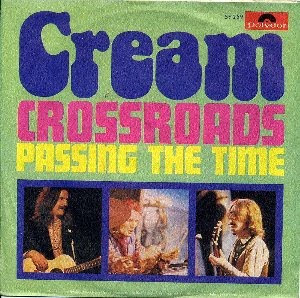
German 7-inchCream is jamming; I don't know what it is you call what those other guys do. Maybe an adaptation of the term that I use for boring postrock bands ("noodling") describes it as well as any.

Regardless as to what it is these pretenders do, listening to Cream take flight into their best improvisations, whether in the studio as here, or live (as on "I'm So Glad" from Goodbye), is still thrilling for me, even after having known the material for years and years. Their ideas were just that good.

What's kind of interesting here is how Clapton is the guy in the background during the instrumental workout. Baker--still the only drummer I've ever cared to hear a drum solo from--and Bruce--who may not be my favorite bassist of all time, but would be in any top five list I might make--are both in the forefront, while Clapton sounds like he's comping, supplying the rhythm as his rhythm section goes free-form.

The song is credited to drummer Ginger Baker and to Mike Taylor, and it is to be supposed that Baker handled much of the lyrics, while Taylor handled most of the music. Taylor--a pianist--had played with Baker in trad jazz bands in the early '60's, and had, by the time Wheels of Fire was released in 1968, put out two albums of his own that had become semi-legendary in the annals of British jazz.

He was also by 1968 homeless, a complete schizophrenic, and an acid-gobbler of tremendous consumption. Within a year, Wheels would ship 500,000 copies, and Taylor would be dead. His bloated, partially decomposed body was fished from an outlet bay to the Thames River in January of '69. The coroner noted that the body was at least two weeks old, but declined to cite a cause of death.

Whoah. Sorry to harsh your Christmas, there. Sometimes I get carried away with the twists and turns of things, if you hadn't noticed. Anyway, what's important here is that Taylor (who also co-wrote the amazing "Pressed Rat and Warthog" with Baker) had been known as an inspired composer; Ginger, not so much.

But, boy, the Cream drummer could write himself some lyrics. "Pressed Rat's" were psychedelia at its absurd finest, and the calliope and glockenspiel section of the song under consideration today features concrete, evocative language that transports the listener into the lonely woman's wintry world.

Hearing Jack Bruce warble on about the roof being a white blanket or about the icicles on the windowpanes truly puts a picture in the mind's eye. I picture an isolated house on a snowy hilltop. A few evergreens dot the hillside and a pebbly path from which the snow has been cleared winds lazily up the hill.

White smoke issues forth from a brick chimney into a clear blue sky. Wreaths dotted with berries and pinecones have been placed above the doorways, and candles twinkle through the iced windows.

There are worse places to pass the time, for sure. I've lived in South Florida my entire life, so a white Christmas has always been something of an abstraction to me. It's something other people, living in more normal places, might have. Well, I'm still stuck here, but here's wishing you a Christmas that looks (if not feels) like the calliope and glockenspiel portions of "Passing the Time."

I totally stole this image from a religious art site, so am providing a link just in case you want to buy the painting . . .


Cream - Wheels of Fire - 03 - Passing The Time.mp3

This file was removed May 22, 2010. If you're still way interested in coming up with a copy of this--and really can't figure out where you might get one--drop me an email and I'm sure I'll be able to figure something out for you.

File under: Supergroup Rock, Merry Christmas!

*I don't see anywhere that Cream ever considered calling themselves "The BBC," but they totally should have. (Return)

Monday, December 21, 2009

Kansas - "A Glimpse of Home" From the Album Monolith

In which we consider the most unfairly maligned album from the most unfairly maligned band . . . .

While I think quite a lot of my taste, I don't think so much of it that I don't realize much of what I listen to might be open to some criticism from those of certain, more sensitive, opinions.

And realizing that Slayer might not be the music of choice for some practicing Christians is only the beginning of it.

There are those, for example, who find that side-long prog song cycles violate an important expectation of immediacy they take from rock and roll. And there are others for whom No-Wave or pigfuck noise bands are rendered incomprehensible simply because of the lack of any standard melody.

And I get it. I don't agree, but I get it. The resultant criticism from these listeners is rendered for me, if not valid, at least understandable and fair.

Unlike that criticism which is often lobbed Kansas' way. Although the internet has over the past ten or twelve years brought together the theretofore underrepresented prog fan, and thereby ameliorated some of this un-fair criticism, you still hear it. And I DEFINITELY heard it during my college years.

Kansas were "formulaic", "least common denominator" "AOR" "70's rawk" "crap."

Though of course they were none of these things. They were a PROG BAND, people! But somehow, there are a number of people still, who--twenty years after I rendered a Gainesville carful of stoned Scratch Acid fans speechless with my screaming defense of the band--continue to confuse Kansas with vastly inferior, and vastly less ambitious, bands like Journey, Styx, and Boston.

But as I've considered things for this post, perhaps I've found that's somehow appropriate. There is a duality for Kansas in what they were, and in what they are perceived to have been. But this state of affairs is only in keeping with much else about the band, which found its mission and its art and nearly everything else in a near constant state of conflict between two opposing visions of itself.

Forget that the band had 2 lead singers, 2 guitarists and 2 keyboardists, though even there, the symbology is nice. Consider instead that the band began as a unit who couldn't decide whether they were a progressive band who could do the Southern rock boogie, or a boogie band who liked to prog out. After some infighting, Kerry Livgren exerted his influence, and the band decided it was the former. And so they entered a phase in which they became the world's rockinest progressive band . . . .

Lark's Tongue- and Red- era Crimson aside, Kansas didn't really even have that much competition. I won't argue that Kansas were a better band than ELP, but I also don't think anyone could argue to me that they weren't heavier. Livgren's fills and leads in the center section of "Icarus: Borne on Wings of Steel" have become iconic not as an expression of prog ideals, but rather as of the rock guitar. I like the fills on "Tarkus," but you're not going to find yourself saying the same thing about Greg Lake's work, you know? The only thing iconic about ELP is the E, and E pounds the keys. Which don't rock as much.

Again to Kansas' duality: at their height, between 1975 and 1980, there was no band anywhere that did the two things they did so very well. They did the Skynyrd things as well as Skynyrd and the Yes things, if not as well as Yes, goddamned well enough. They led a split life, and did so seemingly effortlessly, consolidating their fans with ascents up the Top 40 charts, and live shows with lasers and smoke machines and who knows what else that made prog fans of teenaged kids who would have been all against it had it ever been explained to them explicitly. They wrote and played cult music, but made the top of the charts. They seamlessly functioned as both an American-style rock band, and as a British-influenced prog one.

They weren't the best rock band in the world, but they were the most unique. Even their few imitators, like the Dixie Dregs, were just that.

But even as they had turned their core dualities into a world-class strength, another was working to rip them apart. Livgren, as, umm, glimpsed, through his lyrics had always seemed something of a seeker, as he invoked the deities of Buddhism in "Incomudro," name-dropped Cain from the Book of Genesis at least twice on Masque, and wrote frankly of his wish for spiritual breakthrough in "The Wall."

By the time recording for Monolith commenced, Livgren in his search had become a devotee of The Urantia Book, a massive Gnostic-like text that according to Wikipedia:
[a]mong many other topics . . . expounds on the origin and meaning of life, describes humankind's place in the universe, discusses the relationship between God and people, and presents a detailed biography of Jesus.
Livgren, never the most circumspect, wasn't shy about transmitting his new spiritual precepts through his lyrics, and his joy at having found them, too, as may be safely gathered by giving the words to "Glimpse" a quick scan.

It may also be safely gathered that Steve Walsh, the energetic (sometime) frontman who did half the singing and all the keyboard handstands, was not so impressed. Walsh had already nearly left the band over its direction before the Point of Know Return sessions, and his fight to keep the band secular as the band's main songwriter evolved from a seeker into a born-again Christian would eventually rip the band apart, but not before it had fashioned this Monolith, one of the most brilliantly conflicted records in all of prog, or indeed, in all of rock itself.

What makes it a fascinating listen is that Livgren didn't sing. It was Walsh who, most often anyway, took on the task of making Livgren's cosmic lyrics microphone-ready.

"A Glimpse of Home" begins like the Main Street Electrical Parade, but by 0:53 it's made its dualistic u-turn and has gotten very heavy indeed. The rhythmic breaks (most likely supplied by Rich Williams) are heads down boogie--except that Phil Ehart's drumming behind is typically precise and complex. But most remarkable of all is Walsh's voice, raspy in the effort and strained in his intensity as he poured his soul and gave his all into making the very lyrics he believed were destroying his band as powerful, and as heavy as they could possibly be.

Walsh was of course not a hero or a martyr; he has spoken plainly about the fact that he was something of "primadonna" at this time. And the direction he wanted Kansas to go in was not only more secular than Livgren's, but also more poppy. He liked the ascent up the Billboard charts most of all in the band, and wanted to return, often. Walsh with his road songs and his drug songs WAS a grounding influence on Livgren's Icarian flights of fancy, but we need to keep in mind also that Livgren at his heaviest was heavier than Walsh was at his.

As an atheist, I would find it easy to blame Livgren (and bassist Dave Hope, who also found God) in his proseletyzing ways for the demise of Kansas as an artistic force when they had been so very goddamned special. But my appreciation for prog, and for truth, allows me to realize that what made the band great was probably what doomed it.

Although the barely contained conflict would blow up quickly thereafter, as Livgren and Hope got Born Again, as the band phoned in an album, and Walsh just up and quit, at least for one record, the conflict as worlds collided was a truly remarkable thing to hear.


Kansas - Monolith - 05 - A Glimpse of Home.mp3

This file was removed April 13, 2010 after I received a DMCA takedown letter. If you're still way interested in coming up with a copy of this--and really can't figure out where you might get one--drop me an email and I'm sure I'll be able to figure something out for you.

File under: Progressive Rock, American Branch

Thursday, December 17, 2009

The Big Five Oh

Hey.

The White Stripes post was post number 50 on this blog, which seems to me to be a respectable number, considering that December 3 was the one year anniversary of the first post, and that I went on writer's block hiatus for four months.

50 posts in 54 weeks. I'll take it. And I think that, instead of that two posts per week lunacy that I used as a goal and as a benchmark when I started the site, I'll move forward with this blog using a post more or less every week as my goal.

And that's because I love music and when I can nail the feel of a song, I love the results, but boy, oh boy, writing about music is hard.

When I ran The Crawfish Boxes, I posted ten times a week during the season, and a lot of it managed some quality, too. The baseball writing came easier, somehow.

Maybe because in baseball, there're always facts to fall back on. Roy Oswalt is 23 - 1 lifetime vs Cincinnati; Humberto Quintero has never hit a home run in April. When you're not feeling particularly creative, but still have a 7:05 first pitch you have to beat, you can always lash together a few raw facts, as Bill Murray once said onscreen, and get yourself to the end of a fairly well-constructed post.

The only facts you can appeal to in music writing are the irrelevant and boring ones, like this band is from here, or that band is from over there, and they each played gigs coming up with Band X, and I just do not want to write in that fashion.

So that's why I make it hard for myself, and that's why it IS hard. But I like the results and I'm going to stay with it. I believe in the work I've done here. Even when I was in the midst of my hiatus, even when I couldn't for the fucking life of me think of anything meaningful to say about just about anything musical, I still knew that I would eventually come back here.

Sadly, it was Alex' death that finally kicked me in the ass, finally got me going again. I wasn't Alex' closest friend, far from it, but trying to codify my thoughts on that horrible tragedy congealed the slippery goo that my thoughts had become. Something had happened that put my terror of not being able to write anything worthwhile in focus.

I might as well say it now: I'm going to slip again. At some point I'm gonna go a month or two moving forward without being able to write. Might as well say it now, so whoever's reading if anyone will know. So I never have to think I'm letting anyone down, I'll be upfront right now.

But any such lapse seems far off right now. I've got a head full of ideas just now, not to jinx things, but maybe the way a word galaxy might filter some good lyrics that could then be rearranged, or how how you might be able to approach two songs by combining and shuffling the words in their lyrics. Or maybe a poem about Soft Machine's Third: Lord knows I've been unable to approach it in any other way, despite wanting very badly to write about that uncanny masterwork.

More like that Procol Harum piece. I *loved* that. And more fake interviews, like the one I invented with Pelle Almqvist.

I sincerely hope to bring those things to this site, and I hope that there will be readers for them, and commenters, too. If you have been either, I thank you, and hope you soon have company as I continue to work here.

Tuesday, December 15, 2009

The White Stripes - "Girl You Have No Faith In Medicine" From the CD Elephant

The White Stripes Elephant CD cover

Man, I love Meg White's drumming in this song. Given Jack White's prodigious talents, it probably seems somewhat like recommending Ruth's Chris for the mashed potatoes to say so, but damn the torpedoes, you know what I mean? We're used to moving forward here with the truth of things.

I would imagine that Meg doesn't score too many points with the Neil Peart crowd for her stylings, but note well about her this, she sure as hell is enthusiastic.

At first, on "Girl You Have No Faith In Medicine," you don't even notice the percussive lower end, because her high hat/ride cymbal work is so constant. It's like an all-pervasive white noise about things, like Jack's guitar is having to push itself through a snow storm.

But dig deeper and you'll find the heartbeat beneath.

BOOM Bap BOOM BOOM BAP, bass drum, floor tom, having the shit beat out of themselves the whole way through, from when Meg comes in at around :07 til the very end. Except after each one of Jack's lead breaks, like the set of four vocal breaks beginning at :45, or the set of four guitar breaks starting at 1:34. THEN Meg comes in with an extra BOOM a half beat early before the song restarts. And it's that extra BOOM that makes the song so propulsive, that moves the song through its paces so powerfully.

Listen, there are all kinds of fools out there, talking about how shitty a drummer Meg is, how Jack or Jack's songs deserve better. There's even a clown on You Tube all proud of how his drum work on his video complicated the drum part of this song until it no longer even functioned like a heart.

But what Meg does here, what Meg does a LOT of times, actually, is all that anyone playing music ever really needs to do: she plays with fervor, and she plays aggressively, moving the song forward, instead of waiting for it to move her.

Of COURSE Jack is the more talented White Stripe. If you doubt that, just consider that he somehow found a way to rhyme "acetaminophen."

And of course musical talent matters. If it didn't, you would have never heard of a whole lot of bands whose distinction flows out of just that, from King Crimson to Tool to Tortoise.

But if you're gonna play rock and roll, firstly, you've got to rock. You've got to put the right foot forward first. It's why The Ramones were a better band than Gentle Giant, and it's why, caterwauling detractors be damned, Meg White kicks so very much ass as a drummer. . . . .


The White Stripes - Elephant - 13 Girl You Have No Faith In Medicine.mp3

This file was removed May 22, 2010. If you're still way interested in coming up with a copy of this--and really can't figure out where you might get one--drop me an email and I'm sure I'll be able to figure something out for you.

File under: Color Co-ordinated Rock

Friday, December 11, 2009

The Sonics - "The Witch" From the Album Here Are The Sonics and
The Hives - "No Pun Intended" From the Album Tyrannosaurus Hives

The Sonics Here Are The Sonics album cover The Hives Tyrannosaurus Hives album cover

Always stumped for ideas, I was thinking about maybe writing a post where I was shooting this imaginary game of pool with the lead singer for The Hives. And then I thought, well, what if I did the research, and what if I found out that, to a man, the members of the Hives reject billiards? What if I find out that they all hate the game? What then?

And so after that I thought--a little confused, I'll grant you--that research was the hobgoblin of small minds.

Fuckin' Misfits! So then, here we are: I'm hanging out with Howlin' Pelle Almqvist at this bar I've dredged up from my memories. It's in New Orleans (or it was), and it has (or had) plenty of smooth, clean tables, and featured the fuckin' Misfits on their jukebox, how 'bout that?
The front door to the joint has been left open and you can hear the raindrops hitting the pavement outside over the muffled sounds of Bourbon Street five or six blocks away. It's hot and of course it doesn't get any more humid. I'm wearing a white cotton button-down longsleeve, and if I couldn't see 'em, I can feel the soggy ellipses in my shirt traced by the dripping sweat under my arms. The fans hanging from the double high ceiling, swirling languidly, don't help in the slightest.

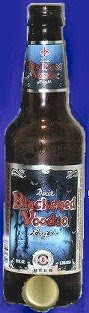
Dixie's Blackened Voodoo:  not sure if this stuff is still around or notSo yeah, Almqvist and I are shooting pool. Since it's my world, and since it's New Orleans, I'm drinking Blackened Voodoo lager. The Hives' frontman is drinking Jameson's with Bass ale chasers. He's wearing black slacks, a black vest and a black shirt with red trim. A red cravat is tied aound his neck. I think to myself that he's got to be just about parboiled in there. His hair, now sweatslick, is parted at the side and combed over. His pupils are tiny, and he's frantic from one moment to the next. He calls nine ball in the side pocket, and I shake my head, mutter to myself, "tough shot."

Pelle slows down for a second, looks me in the eye and says, in his slight Scandinavian accent, "I'll make it, my friend."

His shot doesn't go as planned. Instead of hitting the nine, the cue ball hits the three, which hits the thirteen which kisses off the opposite rail . . . and squarely hits the nine, which drops into the side pocket.

I shake my head again, resisting a smile, and Almqvist quickly jumps onto the table, spreads his legs wide apart, looks down at me, and shouts, "I hate to say I told you so, but I told you so!"


The cashier in his booth stands up, and yells, "hey!" and Pelle rapidly descends from the table, but the rest of the match goes similarly. When he breaks, he screams, "a get together to tear it apart!"

When he knocks my seven ball away from the corner pocket, where it had been blocking his stripes, he says it had been his "main offender."

And so on and so forth.

Eventually, slightly annoyed at the histrionics, I take off my glasses and look at him. "Howlin' Pelle," I say, "why don't you give it a rest? You're with a friend. I know your songs, man."

"Ahh," he replies, "but did you buy The Black and Blue Album?"

He has me. "No," I admit. "But I downloaded some of the songs," I say with the complete and utter honesty you always ascribe to yourself in dreams and other imagined scenarios.

"Now see what I mean?" he asks me, bringing his fist down softly against the forest green felt in front of him. The cashier is watching him warily.

"Actually I don't. None of the songs you quoted were from The Black and Blue Album, I'm realizing. And Lord knows I've given you plenty of opportunities to scream 'Try it Again.'"

My words hang in the air awkwardly even as the billiard balls on the tables around us continue to clack as they collide, even as the steaming bayou rain continues to fall outside.

I attempt to smother the awkward silence. "You know, Pelle, I love the suits. A lot of people say The Beatles were never as good again once they stopped wearing suits."

Pelle gets back to the game, leans over the table, studying a cross-table shot involving his six ball. "You know, you can talk to me--you can talk to us, to Niklaus and to the rest of us--about the Beatles. Not like those Gallagher Brothers, for ten years if you mentioned the Fab Four, they'd go into a fucking conniption fit."

Well, well, well. "Sure, the Beatles. But really," I say thoughtfully, or at least hoping a thought will come, "when I think of the Hives, I'm reminded of The Sonics. Talk about a singer who could howl. Everybody covers the Sonics, but I think only the Hives could bring something additional to 'Cinderella.'"

Almqvist shoots and drops the six. The shot that went awry notwithstanding, he's a good player, beating me consistently, that's for sure.

"We used to cover 'The Witch' in Fagersta," Almqvist tells me as he chalks, careful to keep the blue dust that flies off away from his slacks. "Crazy fucking song. And Christian always talks about how manic their drum sound was . . ."

"Kurt Cobain said something about that, too, I think."

"Ah, fuck Cobain," Almqvist says to me, dead earnest. He turns away from me and communicates to the waitress via hand signals that he wants another Jamison's and that he wants another Bass. Turning back to me, he says, "I'm tired of hearing about Cobain. The man's been dead for fifteen years, and still he hasn't the decency to go away. Nirvana had one-tenth the sophistication of either The Sonics or The Hives. . . ."

Almquist's comment pisses me off, because, you know, I like Nirvana. "I always thought that Bleach--while not exactly garage--had the same purity and the same intensity," I say, as evenly as I can manage. "And you know, growing up in Aberdeen, I bet Cobain heard the Sonics before he was fourteen years old."

The waitress brings Pelle his drinks. "You might have a small point. But if Bleach owed part of itself to the Sonics, by Nevermind all Cobain wanted to do was sound like the Pixies. And I have no use whatsoever for that band, none at all. And here's what else: where was Cobain's showmanship, man? Kurt staring at his amps for two hours doesn't cut it if I'm in the audience, friend. You ever watch Nicholaus Arson play his guitar during a show? He's a clear and present danger. My God, this planet in its post-Cobain rapture needs The Hives so very much. If there really was a Dr. Rock, his prescription to the world would be us."

"You know, six or seven years ago, they said that The Hives were part of the 'garage revival,' but the revival was short-lived, and the patient's gone terminal. The movement's dead--even Jack White is playing the blues in Nashville these days--but The Hives have transmuted and they have survived. We're not as heavy as we were, and we shouldn't be. We're not very punk any more, and we don't want to be."

He drains his ale in one draught, and takes what I now realize to be the last shot of the game and of the match. "Far corner," he says, as we both watch the eight ball roll smoothly across the felt on its way into that very pocket.

Shit, I just got dogged. I think it was four games to one. That's the last time I fucking play imaginary pool with a cocksure Swede who hates the Pixies, I can tell you that.

Almqvist starts taking his stick apart, and tells me, "I'm meeting someone at Landry's soon. Thanks for the games. It was great to play, I rolled you, so . . . . No pun intended."


The Sonics - Here Are The Sonics - 01 - The Witch.mp3

This file was removed May 22, 2010. If you're still way interested in coming up with a copy of this--and really can't figure out where you might get one--drop me an email and I'm sure I'll be able to figure something out for you.

File Under: Garage

The Hives - Tyrannosaurus Hives - 04 - No Pun Intended.mp3

This file was removed May 22, 2010. If you're still way interested in coming up with a copy of this--and really can't figure out where you might get one--drop me an email and I'm sure I'll be able to figure something out for you.

File Under: Garage Revival

Note: the opinions expressed by Pelle Almqvist in this blogpost do not necessarily reflect those of La Historia De La Musica Rock, nor do they, for that matter, necessarily reflect those of Pelle Almqvist.