Monday, December 29, 2008

Wire - "Pink Flag" from the Album Pink Flag and
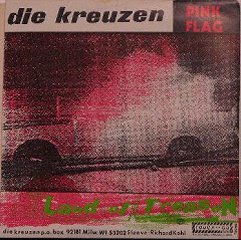
  die kreuzen - "Pink Flag" (T&G62A)

Wire Pink Flag CD coverdie kreuzen Pink Flag 7-inch cover

Wire provides us with an original art punk gem from 1977 and die Kreuzen provide us with a drone punk rendering from 1990.

Wire were of course genius, but you might make the argument that die Kreuzen's spaced out guitar sound suits Wire's impressionistic lyrics even better than the original arrangement did.

While Wire was always crisp and angular, die Kreuzen stretch the sound of the song, the sound of the guitars, that is, pull it like chromium taffy into this near-infinite delay, and then smash the whole lumpy ribbon of sound they'd just made, so that what had been distinct, choppy, arresting is now distorted, broken, and warped.

The difference between Wire's original and die Kreuzen's cover is the difference between a zig zag pattern etched into zinc plate, buffed clean, and the pattern made by a sponge dipped in paints, silver/chrome and crimson and yes, pastel pink, all smeared together, as it is dragged freehand sidewise along a long, bumpy wall.

Wire - Pink Flag - 10 - Pink Flag.mp3

This file was removed February 9, 2009. If you're still way interested in coming up with a copy of this--and really can't figure out where you might get one--drop me an email and I'm sure I'll be able to figure something out for you.

File under: Art punk

die Kreuzen - Pink Flag (T&G 62A).mp3

This file was removed February 9, 2009. If you're still way interested in coming up with a copy of this--and really can't figure out where you might get one--drop me an email and I'm sure I'll be able to figure something out for you.

File under: Covers where they change the words

Wednesday, December 24, 2008

Emerson Lake & Palmer - "Nutrocker" From the CD Pictures At An Exhibition


ELP - Pictures At An Exhibition CD Cover

On this Christmas Eve, down from Peter Ilyich Tchaikovsky, to Kim Fowley through B Bumble (whoever *he* is), to Keith Emerson, from me to you, a progressive rock retelling of a boogie-woogie/rock 'n' roll remake of a classical march taken from the score to a ballet performed each Christmas the world over.

Hot damn.

Keyboardist Keith Emerson is, as usual for him, as subtle as a jackhammer in his muscular performance upon the clavinet, but there's no denying the thing's a blast to listen to.

Well, OK-- maybe there's been some denying. The reviews of Pictures at Ground and Sky, while pretty much scorching the album overall, take quite a bit of issue in particular with the capstone to the record that is "Nutrocker," calling it "goofy," and an "insult" that is "cheesy" and inessential.

Well. Though I love me some Emerson Lake and Palmer, that love is mostly for Tarkus and Trilogy and the first one, so I really can't get into a defense of the album overall.

But the disrespect of "Nutrocker"--and from supposed prog fans no less!--kind of gets into some areas where I think ELP are unfairly maligned, so I'd like to (ahem) go into them for a moment.

I'm a child of the seventies, but one that came of age after the Ramones and the Sex Pistols had done their work. Which is to say, after they had made progressive rock (in its first flowering) more or less obsolete, at least in the eyes of the tastemakers.

The Hut of Baba YagaJon Marlowe from the old Miami News wrote the review that got me to go out and buy Rust Never Sleeps, while presciently championing all kinds of awesome scuzz rock that gets worshipped now in retrospect--but he hated prog, once calling Kansas "the band that are not a band." Creem had as much to do with my buying White Light White Heat as any earthly condition--but chief scribe Lester Bangs' hate of ELP was, and is, legendary.

But as I said then, and will say now, what the fuck? An oft- and ill-used canard about prog was that progressive rock bands were pretentious, that they took themselves too seriously. Like the Velvet Underground didn't? but more germane here, ELP DID NOT take themselves too seriously. If ridiculous jokes like "Jeremy Bender" or "Benny the Bouncer" didn't get the concept through, then "Nutrocker" here should be the last, umm, exhibit required to convince.

If you told me that Keith Emerson liked to show off, I'd say, "yeah and so what?" And if you told me that ELP didn't understand that a tongue in cheek helps when listening to prog, I'd say you were dead wrong.

Anyway, with that in mind, I'd like to list before I wish the world a Merry Christmas my three funniest things about Keith Emerson and ELP:
  • "Country Pie/Brandenburg Concerto No. 6" -- a track from The Nice's Elegy; Bob Dylan and JS Bach, together at last. The deep humor here HAD to be intentional. Right?


  • Welcome Back My Friends to The Show That Never Ends . . . Ladies And Gentlemen, Emerson Lake and Palmer. Yes carried off their Triple Live so much better. . . ..


  • The exclusive limited edition Knucklebonz sculpture. Not that the Dimebag Darrell isn't funny, also.


  • Emerson, Lake and Palmer - Pictures at an Exhibition - 12 - Nutrocker.mp3

    This file was removed February 6, 2009. If you're still way interested in coming up with a copy of this--and really can't figure out where you might get one--drop me an email and I'm sure I'll be able to figure something out for you.

    File under: Merry Christmas!

    Monday, December 22, 2008

    Pelican - "The Woods" from the EP Pelican

    Pelican EP CD cover
    As much as I like the concept of a modern metal band without vocals--meaning there's one less thing you have to overlook in order to like them--I like the title (and the thrust) of this song even more.

    Working within a genre that so often looks to an overworked Christian mythology for its symbols of heaviness and "evil," Pelican here point to something much more primoridal for their dark symbology, reminding us that if you take the racial memory back far enough, there was once nothing more terrifying and evil than whatever it was that lay past the treeline.

    Think, if you can, of a Little Red Riding Hood removed of the ironic Looney Tunes veneer we veterans of the Industrial Revolution have brushed over it. Think past the Brothers Grimm, who were sometimes waylaid by their dreams of German unity. Think, instead, of the source folk tale, of the menace of the wolf, the very deadly dangerous and cunning carnivore of the deepest darkest reaches of the Woods, bloodthirsty and absolutely unpredictable, long powerful jaws dripping with drool, likely to attack at any moment, to leap from the shadows even in corners of the forest you had been naive enough to think might have been safe.

    Or think of the cannibalistic witch of Hansel and Gretel, whose sinister phantasm trap of a gingerbread house also lay deep within the forest that is considered by the stepmother to be nothing less than a death sentence for the two children. Or of the similarly anthropophagic Baba Yaga, whose home within the Woods rested on magically animated chicken feet, and whose palisade without was made of human bones, with a ring of skulls perched atop.

    These are the myths we created once upon a time in order to explicate our fear of the dark and of the unknown that lived within the Woods. And though we've forgotten about them now, or turned them into Saturday morning cartoons, the way that they rationalized our most primal fears was once essential.

    Baba Yaga
    These ultimately pagan myths of the ogres, monsters, wolves and witches rumored by fabulists to dwell within harken back to the neolithic Hercynian Forest: a vast, dense, dangerous place where the sun could not reach and where man for the most part was nothing more than additional prey. It was a place where he simply did not belong, and the consequences of being caught there were dire indeed.

    This is all grave, powerful, heavy stuff that taps deep into the medulla, and as the Pelican tune awakes, and stirs, as it throbs with menace, as the minor key dissonance explodes into a thunderous roar, as the final chase through the dark copses plays out, all you can think of as the listener is how perceptive Pelican were to tap into this, and remind us of the older, primordial fears.

    'Coz Slayer are a great band and all, but in the end, Pelican are here to remind us that, when it comes to horror and dread, Satan's nothing more than a goddamned newcomer.

    Pelican - Pelican - 04 - The Woods.mp3

    This file was removed February 5, 2009. If you're still way interested in coming up with a copy of this--and really can't figure out where you might get one--drop me an email and I'm sure I'll be able to figure something out for you.

    File under: Post-metal

    Thursday, December 18, 2008

    Fear - "New York's Alright If You Like Saxophones" from the Album The Record

    Fear - The Record CD cover
    As singer/actor/auteur Lee Ving is very much aware, what's going on in this song is the demarcation of a cultural divide. East Coast/West Coast, Apple/ Angels, "Saxophones" draws the lines (at least from the West Coast perspective) in the battle between Los Angeles and New York, and that battle is over much more just the two metropolis's brands of punk rock.

    Yeah, it's about Ramones vs. Black Flag, Voidoids vs. Fear, but it's also about tons of other things: subway vs. freeway, the Village vs. the Strip, the Pacific Ocean vs. Long Island Sound, the MOMA vs. Universal Studios, smog vs. garbage, and probably as much as anything, Woody Allen vs. the whole goddamned collective.

    You can surely ask how much Ving is into the films of Woody Allen, but for me, if the pro-LA, anti New York point of view is just about summed up by "New York's Alright If You Like Saxophones," then the pro-New York, anti-Los Angeles side of things would be stated by Allen, or at least his later, less funny, films.

    I mean, I know that the neurotic jew schtick has by now gotten old, and that Allen's idea of modern music is something like Paul Whiteman, but stay with me, it's worth it: Allen's films starting at about Annie Hall are not only love songs to New York City, they are pretty direct in their hatred of LA, and are therefore definitely salvo in the East/West culture wars.

    So yeah, that's it: this song is Part Two of the Steel Cage Death Match between Woody Allen and Lee Ving, initiated and continued over the cities they each hate. The Woodman had laid down the gauntlet in Annie Hall, calling LA "Munchkin Land" and five years later, Lee Ving comes back and speaks on behalf of the City of the Angels, telling us in no uncertain times that New York's best if you've got a terminal illness.

    My love of Sonic Youth notwithstanding, I'm pretty sure I'm with Ving on this one, but, of course, you're free to judge for yourself

    Too cool for Graphjam--or I can only surmise

    Fear - The Record - 5 - New York's Alright If You Like Saxophones.mp3

    This file was removed January 30, 2009. If you're still way interested in coming up with a copy of this--and really can't figure out where you might get one--drop me an email and I'm sure I'll be able to figure something out for you.

    File Under: Youze all suck, who don't tink so?

    Monday, December 15, 2008

    Medeski Martin & Wood - "Whatever Happened to Gus" From the Album Combustication

    Medeski Martin & Wood Combustication CD coverA postbop dreamstate, a figment of rotgut bourbon and scotch, a scrapple in the Apple on a bright sunny morning that exists only in some jazz poet's crazy-ass mind.

    Zoot suits and porkpie hats, and cigarette butts, way back when, about Bird and Roach, figure 8 jam-sessions locked tight, chasing that shit hard, only you couldn't figure what the hell Bird was doing with his arms around Wynton Marsalis' shoulders. Saxophone cases resting against the brownstone walls, left empty in the bebop hallucination, everyone's split. All culminating in the perfect beatific vision, scads and scads of these fantastic jazz musicians, one after the other, descending into the City, rows upon rows of them, all dressed in coat and tie and dark sunglasses, hustling and running across the Brooklyn Bridge.

    And say, man, you got the key?

    After you tip your hat to narrator Steve Cannon (and without offense toward Chris Wood's very athletic bass-playing), you find that the key to this very fine, very historically-oriented, and very very freaky tune is John Medeski's mellotron. And just like Cannon says, that's when I did my research.

    For those of you who have long since forgotten or even never knew Days of Future Passed or In the Court of the Crimson King, the mellotron was one of the earliest polyphonic keyboard synthesizers, being introduced in the mid '60's, and seeing some of its most prominent usage on the two proto-prog gems just mentioned.

    The M400 mellotron we're talking about, the one that became popular within the nascent progressive rock movement, and the type that Medeski owns today, was electro-mechanical, which basically refers to how undeneath each of the 35 keys is a miniature tape head and roller. Each time you depress a key, 8 seconds of music plays. Then the tape rewinds, ready for the next time you depress the key above it again.

    and there was this one cat who looked just like Lester Young,  then his image kept changing, then he started looking like Billy Eckstine, then back to Lester, then Billy,  then Les,  then BillyThe factory preloaded its mellotrons with a choice of three sounds: strings, cello, or an 8-voice choir. But the thing about the M400 that endeared itself to musicians, and continues to, is that its tapes came in a removeable frame, meaning that artists could, with a certain amount of labor, switch away from the preloaded to sounds to those they themselves created.

    Listening to the tune, and reading about the mellotron just now, Medeski is undoubtedly using tapes of his own creation on "Whatever Happened to Gus." But there's another thing going on with the wobbly, freaky, eerie background behind the slaphappy double bass. Evidently, the M400 had a flywheel that powered each of the keyboard's 35 tape reels. And evidently, Medeski has removed the lid from his mellotron so that he can reach into the machine while playing and retard or even stop the motion of the flywheel to get the fluttery distorted sound of his most current whim.

    There's a picture of Medeski's mellotron here, if you're interested.

    Now, nowhere did I read that Medeski used his mellotron on "Whatever Happened to Gus." But having listened, and having read, I'd bet dollars to donuts that the keening, wobbling, wailing chorus you hear as support through much of the track is exactly that: John Medeski slowing down and speeding up the tapes on his mellotron to better craft the band's soundtrack to Steve Cannon's strange jazzbo poem about the men who used to play back in the day--even the ones whose names you don't remember.

    Medeski Martin & Wood - Combustication - 6 - Whatever Happened to Gus.mp3

    This file was removed January 27, 2009. If you're still way interested in coming up with a copy of this--and really can't figure out where you might get one--drop me an email and I'm sure I'll be able to figure something out for you.

    File Under: Jazz for Druggies

    Friday, December 12, 2008

    Bailterspace - "Retro" From the Album Wammo

    Bailterspace Wammo CD cover

    I found the science fiction theme to the Bellini tune and entry so enjoyable to play with that I think I wanna play with it for another half week.

    'Cause that title is Retro as in "retro-rockets," and not retro, "of or designating the style of an earlier time."

    Bailterspace's Wikipedia page notes in the band "[a] fascination with the interplay of technology and humanity (often played out in metaphors of space travel)," and it's right up front in "Retro."

    The first lines are
    The rockets have landed
    The spacemen are stranded
    Not where they wanna be

    Where's that taking you?

    You know, maybe the 'style of an earlier time' thing does come into it a little bit. Because the flavor of the sci-fi in "Retro" is markedly different from that in "The Best Song On a Starship." While Bellini's song alludes to (and reminded me of) a science fiction that had literary aspirations, Bailterspace's tune is rooted firmly in time before science fiction thought it could aspire to anything.

    I visualize the brightly colored covers of the pulp magazines of the '30's and '40's when I hear "Retro." I see the visions of a future that never actually got here, or now never will.


    The rockets have landedPerhaps you noticed about fifteen years ago, the Walt Disney World people finally admitted that their Tomorrowland attraction had pretty much gotten everything wrong. They removed the "Mission to Mars" and "Star Jets" attractions, and they redid and rebuilt and repainted everything to match the perspective of an imagineer who lived during the '30's and '40's. When, not incidentally, the pulp magazines were at their height.

    I just found out that they've actually given a name to the aesthetic that the Disney folks and all the others who have taken their inspiration from the classic pulp sci-fi mags have been striving for. They call it "Retro-futurism."

    Hmmm.

    Despite it's bright pulphouse colors, Bailterspace's tune is still somewhat downbeat. The spacemen are stranded, after all, and twice we must submit to Alister Parker's anarchic, slashing, violent guitar solos (and who knows what they must be symbolic of). But this is still a brighter future than the one we're currently enduring.

    I'd take it in a second if given the chance, but I'm not gonna get it. I'm stuck in this world of jihadists and AIDS and recession and the fucking Iraq War, when what Poul Anderson and Vincent Di Fate and Gerard K O'Neill had promised me was jet packs and space stations and flights to the Moon twice daily.

    Good thing I've got this wonderful piece of atmospheric noise pop to keep me distracted.


    Bailterspace - Wammo - 6 - Retro.mp3

    This file was removed January 23, 2009. If you're still way interested in coming up with a copy of this--and really can't figure out where you might get one--drop me an email and I'm sure I'll be able to figure something out for you.

    File under: Rocket roll