Much in the same way that the lyrics to The Beatles' "Glass Onion" acknowledged with a nod and a reluctant wink the gnostic cult of Paul-is-Dead, the packaging of Led Zeppelin's Presence acknowledged the I'm sure at-least-somewhat-discomfitting fact that their group had long since become the most humongous rock band in the world.
 By the time of The White Album, and by the time of Presence, respectively, things had gotten to the point where expedience was no longer expedient. The Beatles had tried not to feed the conspiracy theorists, and Zeppelin--modest at least in this one regard--had stayed away from licensing lunchboxes and appearances on Don Kirshner's Rock Concert. But at a certain point, things get so big, and so plain, that they become the elephant in the room.
Presence seems to be Zep's acceptance of their own status (beyond even their own control) as Big Dumb Object, an enormous artifact of unfathomable consequence.
 That's dumb as in "incapable of speech," not as in "stupid," just so we're straight. But since wee're there, let me note that Presence perhaps more than any Zeppelin album save II demonstrates that a certain amount of stoopidity is unavoidable or even desired if you're going to play the cock-rock game.
 Plant's lyrics to "Achilles" reference some etching or the other of William Blake's, so my point is not to disparage Zeppelin's obvious operational intelligence. Still, Zeppelin were all about contrast: I dare you to check out the live video from '77, and tell me that Plant's suggestive mannerisms as he sings the band's 11-minute epic aren't a little stoopid . . . .
Ah, but I digress, 'cause the key concept here is not "Dumb" but "Big." Think thunder. Think "Hammer of the Gods," if that helps.
After four albums where at least part of the idea had been to leaven the heaviness with keyboards or acoustic instruments, Presence was a return to the undiluted bombast of the second album. Guitar bass drums voice recorded in a mere 18 days--not necessarily simple, but certainly direct.

The instrumental contrasts that for good or ill had been there on III, IV, Houses of the Holy, and Physical Graffiti were absent on the band's seventh album--and maybe that's why it's long been their least popular. Funny thought, that: maybe Zeppelin were so goddamned popular not because of the parts that rocked, but because of the parts that didn't!
 I don't want to go overboard, however. I don't want to make it sound as if Presence were a piece of the nascent pub rock of the time, because the very first track belies that. "Achilles" is the third longest studio track for the band and features perhaps Page's most intricate guitar orchestration, with as many as 12 overdubs. It's routinely described as proggy, or even Yes-like (and if you don't believe that, consider that Dream Theater is one of the many acts who have covered the song). And note that Jonesy is playing an eight-string bass.
Leave it to this band of contrasts to feature a 10-1/2 minute song about a Greek demigod with painstakingly multitracked guitars on their back-to-basics record . . . Presence is perhaps Led Zeppelin's most misunderstood album, but for Page Plant Jones & Bonham, that may have been The Object all along.
Led Zeppelin - Presence - 01 - Achilles Last Stand.mp3
File under: Bands that were, like, really into Bullfinch

.gif)


 It's true that Marino played Cal Jam II in March of 1978, and it's also true that show drew something like 300,000 people, but the album's liner notes tell us that Live was recorded on the band's "1977 tour" in the "Southern United States." Those same notes specify that some of that material was actually recorded in South Florida. This would have had to have been at the Hollywood Sportatorium; there was no other sizable venue for rock 'n' roll shows here at the time. It varied from show to show, but the Sport's seating capacity for rock shows was nine or ten thousand, which is not to say that Marino and his band were drawing those kinds of numbers in '77.
  Which brings us back, I think, to live music, like the kind that is on the Mahogany Rush album we're looking at today. Of course, Mahogany Rush was ALL ABOUT Frank Marino. The backing band, Jimmy Ayoub on drums, and bassist Paul Harwood, were extraordinarily loyal to Marino, but not really otherwise distinguished. There's actually a really good song on What's Next called "Finish Line," where Marino goes off on this flight of the bumblebee solo, all classically influenced, and the guy is flying, he's soaring, but what keeps the track from becoming absolutely transcendent was the rhythm section, who frankly have trouble keeping up.
 And he does jam. The riffs which issue crystalline from his beloved SG may not always be the most original, and in fact, there's a lot of times when he's playing a phrase and you think to yourself, 'I've heard that before.' But it's rare that you've heard it played so well. Marino's playing style is infused with all the whammy bar divebombs and wah wah transforms that percolated through hard rock guitar before Eddie Van Halen and Randy Rhoads changed the game.

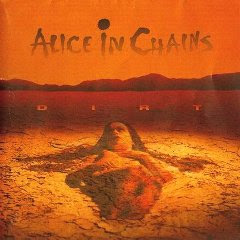

 Not that you can figure it out from the opaque words ("Teach thee on child of love hereafter"), but Cantrell has said that "Would?" is about the death of Mother Love Bone frontman Andrew Wood. But really, I think "Would?" is one of those songs that represents a little stronger if you let the vocals wash over you devoid of meaning; that way you never have to consider the possibility that it's all so much anguished gibberish.
  I remember an interview with Steve Miller I once read. The interviewer asked Miller some question or the other about Jimi Hendrix, and referred to Hendrix' tragic death or some such. I have never forgotten Miller's response. As our truths have more and more been drowned out by the politically correct niceties, his response was a classic of contrarian plainspokenness. He said that no way was Hendrix' death a tragedy. All it was, was a big waste, and that his (Miller's) primary emotional response to it was anger that such a talent could ever be so stupid as to throw himself, his gift, and all the work he might have done away for no good reason at all.
 I don't remember where I was when I heard Layne Staley had died. But I do remember my immediate response, which was: what a fucking idiot, for doing the exact thing everyone had predicted for him. What a fucking loser, with all that ability, to end up dead, and therefore precisely unable to surprise us in our jaded predictions. Like Hendrix, Staley threw it all away for no good fucking reason that I can see. And like Miller, my immediate response is anger.
 Posts
Posts