Wednesday, April 17, 2019

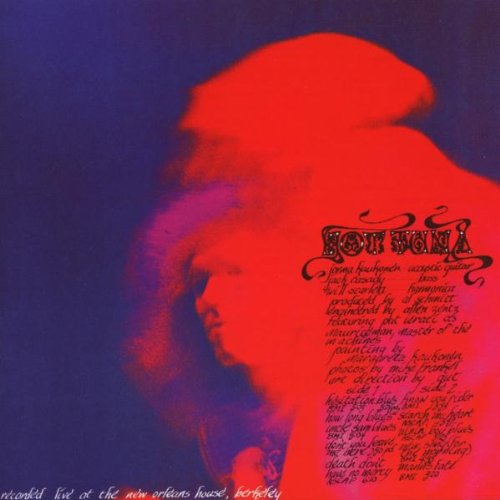
Hot Tuna - “New Song (For The Morning)“
From the album Hot Tuna
(May 1970)

Last song scrobbled from iTunes at Last.fm

Not for the first time, but I heard this uplifting little fingerpicked blues shortly after the sun came up a couple days after my father died, right when I had just started getting used to the idea.

And now, though this song ain’t about the relationship of a man to his father, and though it ain’t really something my father would have liked in the first place, and though he sure as hell wasn’t perfect, everytime I hear "New Song” now, I think about my old man, and get a little misty-eyed.

And I guess that’s alright, it feels kind of good.

    #Time goes on and I get older What am I gonna do

Tuesday, April 2, 2019

Eno/Cale

Eno/Cale
Wrong Way Up
Opal Records

Back when it was new--and I was 25 years old--I eagerly purchased this compact disc. Oh, it was a time, man. The CD was packaged in--get this (if you can: most people today I would assume don't know what it had been)--a longbox. A theft deterrent then, and a music geek collectible now. Funny the way things transform, sometimes.

So. It being that time, I didn't know as much about Brian Eno or John Cale then as I do now, but I still knew Here Come the Warm Jets and White Light/White Heat. And because those records had been great, I expected Wrong Way Up to be pretty awesome.

Did I know then that the 3-1/2-minute revolution called "Sky Saw" featured Cale? Or that there was a cult album named June 1, 1974 that featured them both?

Not sure. Wise now, was I wise then?

Anyway, the excitement before the purchase turned into disappointment afterwards. This album, it did not rock, it bore no traces of Warm Jets or White Heat, and it wasn't weird at all, and I sold it and I forgot about it as quickly as possible.

Lately though, nearly 30 years later, thinner of hair, and wiser of the music, man, I've been on an Eno jag, and I came across a review of the album on Pitchfork that suggested the album, synthpop though it was, achieved nothing less than brilliance in its rather conflicted creation.

Hell, I hadn't even known that the artists hadn't gotten along. . . . So I figured, what *had* I known, in my judgement 30 years ago? I'd been only 25, and had probably been a little bit um, over-influenced, by hardcore punk. My tastes are more sophisticated now! I could like an album that maybe wasn't so manic. Really I could. And shit, everything I've been doing for the last month was all about what a fucking genius Eno was. . . Maybe I'd been hasty in my dismissal of WWU back then, simply because it didn't sound like "Third Uncle," or "I Heard Her Call My Name." 'Cause hell, on reflection, thinking about it in 2019, in the midst of a Brian Peter George St John le Baptiste de la Salle Eno freakout, neither does "Luftschloss."

Goddamn, then, let's try it again, I thought. So last week, I bought a CD copy off Discogs. Received it yesterday, listened to it on the way into work this morning, and ... it's unabashedly awful.

It's lame, predictable, and without a trace of the genius which otherwise marks both men's work. You're tempted to say a few things, although you should probably resist the urges. You're tempted to say that it was a case of men outside the times attempting foolishly to sound like them, but that's wrong. 1990 had no great rush of synthpop albums.

1990 was about Jane's Addiction; Jane's Addiction, and Happy Mondays and Sonic Youth's major label debut. Nobody was making synthpop. That these two major artists felt like going there, I don't know, it's odd, it's strange, it's fucked up.

You're also tempted to say, maybe, if you're not that familiar with the facts, that this was the work of giants who had exhausted their creative energies prior to its making, young lions become old farts. But, of course, that's ridiculous. Five years after this mistake of a record, Eno would record Nerve Net, which showed him as able as his youngself to stretch things out. And if you want pop, shit, Eno made Another Day on Earth in 2005, as he was approaching 60, and that is a brilliant, quirky, intelligent pop record, even if it's not as much like M83 as I might prefer.

Wrong Way Up is a detour into mediocrity. Definite, and puzzling, that is.

It all goes to show many things, perhaps most importantly--and I swear I'm not looking to trash Pitchfork specifically here--that if an artist known for making good things makes something crappy, there will always--always--be somebody around to tell people that, fuck the facts, it is in fact pretty good.

There's also the reminder given that I had the suss of the thing down back in 1990. I like to think of myself as smarter now, wiser if you have to go there, and I was prepared to second-guess myself, and take a lesson from it too, but at least in this case, me and the version of myself that existed three decades ago are smack dab in agreement. There's a stolidity about that I find appealing, but maybe, just maybe, there's also a disappointing inability to evolve.

Funny the way things don't transform, sometimes.

Thursday, March 14, 2019

Brian Eno: 1971-1977 - The Man Who Fell to Earth

Copied from my Tumblr of course

I am only just now beginning to recover from a weeklong Eno bacchanal brought on by the viewing of this 2-1/2 hour film. During this last week, I:

  • Listened to Here Come The Warm Jets straight through at least ten times
  • Purchased the 33-1/3 on Another Green World and read it over two successive nights
  • Purchased the Harmonia '76 reissue, and listened to it in full at least four times
  • Downloaded Cluster & Eno, ripped it to disc, and listened to it all the way through at least three times
  • Downloaded After the Heat, ripped it, and listened to it in its entirety at least six times
  • Used that YouTube to mp3 tool to make files of both sides of that "Once Away My Son" 12-inch with Kevin Shields from Record Store Day last year, then listened to 'em
  • Did the same thing with the files you can find on YouTube of the 1974 John Peel Sessions with The Winkies, listened to them, "Baby's on Fire," "The Paw Paw Negro Blowtorch," "Totalled," and "Fever."
  • Broke out the copy of More Dark Than Shark and especially pondered the lyrics to "Needles in the Camel's Eye" and "Tzima N'arki"

My conclusions other than Brian Peter George St John etc etc is a fricking genius?

  1. "Needles in the Camel's Eye" is the first shoegazer song, a realization which certainly reinforced my listening of that joint with Shields
  2. None of it was truly ambient as I define the term, although Cluster & Eno sure is by God soft
  3. After the Heat is damn well underappreciated.

The funny thing about it all, the funny thing about my characteristically over-the-top reaction to seeing the film, is that the documentary itself is not itself perfect. Eno was not interviewed for the film, and even archived footage is used only two or three times. I'm not really surprised Eno didn't cooperate with the making of the film, but he has led a fairly public life, even if you limit yourself to the time since he for the most part quit making vocal based rock and roll.

It's surprising to me that more footage could not be dredged up. The film instead relies on still photos, and really, the ones you've already seen, that bounced around the screen while critics of more or less considerable credentials talked over them.

They interviewed the gal who wrote the 33-1/3 book, name of Geeta Dayal, and they interviewed David Shepherd, who wrote The Life and Times of Brian Eno, and they interviewed Eric Tamm, who wrote Brian Eno and the Vertical Color of Sound. And they interviewed Johnny Rogan, who wrote a bio of Roxy. These four plus this other annoying bloke whose name I didn't bother to notice were the meat of the movie, although I loved it the couple times they showed Christgau and Simon Reynolds, rock critics ftw!

Brian Turrington of The Winkies--and three of the four vocal albums--told the best stories (and the ones I didn't already know) while Jon Hassell was gone so fast you weren't sure he was there.

So lots of observations, lots of theorizing, and lots of headshaking at the oblique methods from observers and theorists and method actors. But not that much from the man himself, and that's what would have really capped off this properly-directed tribute most effectively.

Sunday, March 3, 2019

Text to Cerveza from the other day

In addition to the promo videos for Helmet's "Give It" and Adrian Belew's "Big Electric Cat," and a bunch of live stuff from the Soft Machine, I watched King Crimson's version of "The Sheltering Sky" from Live at Frejus last night.

Watching Fripp play these nearly inhuman runs defines for you a dichotomy between extremely limited expressed emotion and a very very blistering action in sound.

Saturday, March 3, 2018

Music-Related Comments Elsewhere: At the Audiophle Man, on Vocalists

It began like this: I was following an image search to chase down the truly remarkable Roger Dean album cover for Topographic Drama - Live Across America, the recent Yes live album.

And I came across a review which when boiled down basically said that, even if it opened up the possibility of playing material from Drama, firing Jon Anderson had probably been a mistake.

Nice cover or no, I'll probably never listen to the album, but it *is* a sentiment I probably agree with. Jon Anderson is pretty irreplaceable if you're the band Yes.

But the blog host (who seems like a good bloke) went on to suggest that in pretty much all cases it's the vocalist who is irreplaceable if somebody splits.

And Jim Morrison & Layne Staley, or no, this I could not abide:

The list of bands who have had commercial or artistic success after changing their singers is a long one, and only begins with Genesis. I think of Van Halen, who did it *at least* once. No disrespect to Michael Anthony,, but that band is Eddie and Alex and whoever they want to play with.

I think of Anthrax, who fired an iconic lead singer in Joey Belladonna, hired a reasonable but hardly exemplary replacement in John Bush, and went on to make one of their best albums.

I think of Black Flag. Some people think that the band was best before it hired their longest serving vocalist.

Or if you want me to get back to prog, how about Can? Their recorded output is just about split in half when you file either by vocalist Marvin Mooney, or vocalist Damo Suzuki.

Thinking about it, I’d say that often in a band there is an irreplaceable link, without whom the band loses its identity, no matter how much the remaining members might wish it were not so. Sometimes that band member is a vocalist. Sometimes it’s not.

Beyond that, I am a little surprised at the romanticization of Jon Anderson in the article and in the comments. Iconic voice, sure, and you can argue that he is the irreplaceable link–he might be. But the whole ‘I won’t sing Drama songs’ [thing] was childish and to the touring band’s detriment. I think that his firing was sort of poetic justice after he tried to run the band as an autocrat for so many years, after he fired so many keyboardists 🙂

Wednesday, January 17, 2018

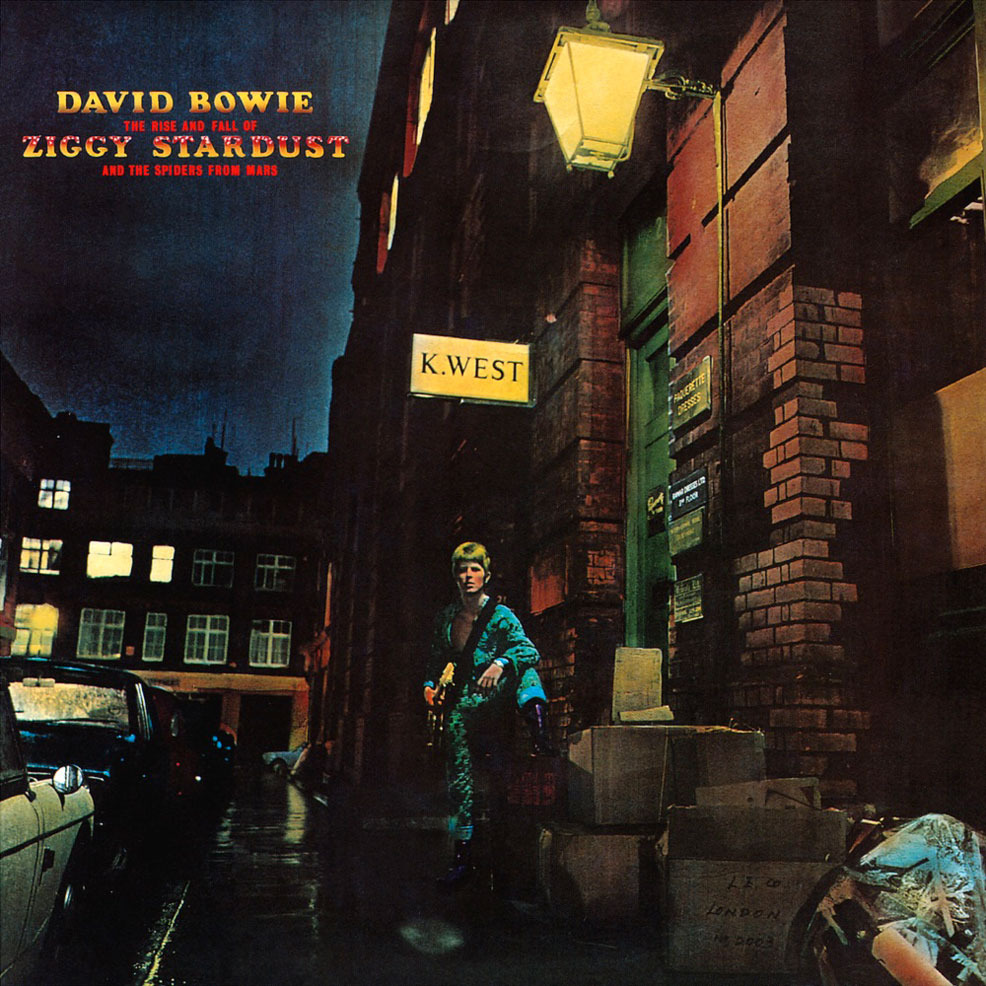
David Bowie - "Ziggy Stardust"
From the album
  The Rise and Fall of Ziggy Stardust
and the Spiders From Mars

(June 6, 1972)

OK, first there was Jesus Christ the Nazarene. Then about 1950 years later there was a beatnik comedian named Lord Buckley, who shortened the epithet of that "coolest, grooviest, swingin'est, wailin'est, strongest, swingin'est cat" to "The Nazz."

Then The Yardbirds let Jeff Beck sing a song they'd written called "The Nazz are Blue." The Nazz here might be the British police, or they might be a group of hipsters who simply know the whereabouts of Jeff's girl (who was BTW named Mary Hughes).

And then there came Todd Rundgren who one day in 1968 Philadelphia started a psychedelic garage power pop band and called it "Nazz" surely after the Yardbird song, and just 'cause it rolled more smoothly off the tongue, Nazz got called The Nazz.

And then all of it culminated when David Bowie called Ziggy The Nazz, and somehow all the antecedent references are rolled into it as he sings. Ziggy Stardust was Jesus Messiah, and the coolest and the grooviest, and a guitar virtuoso, and most definitely a wizard, a true star.

And he had God-given ass, too, whatever that means.